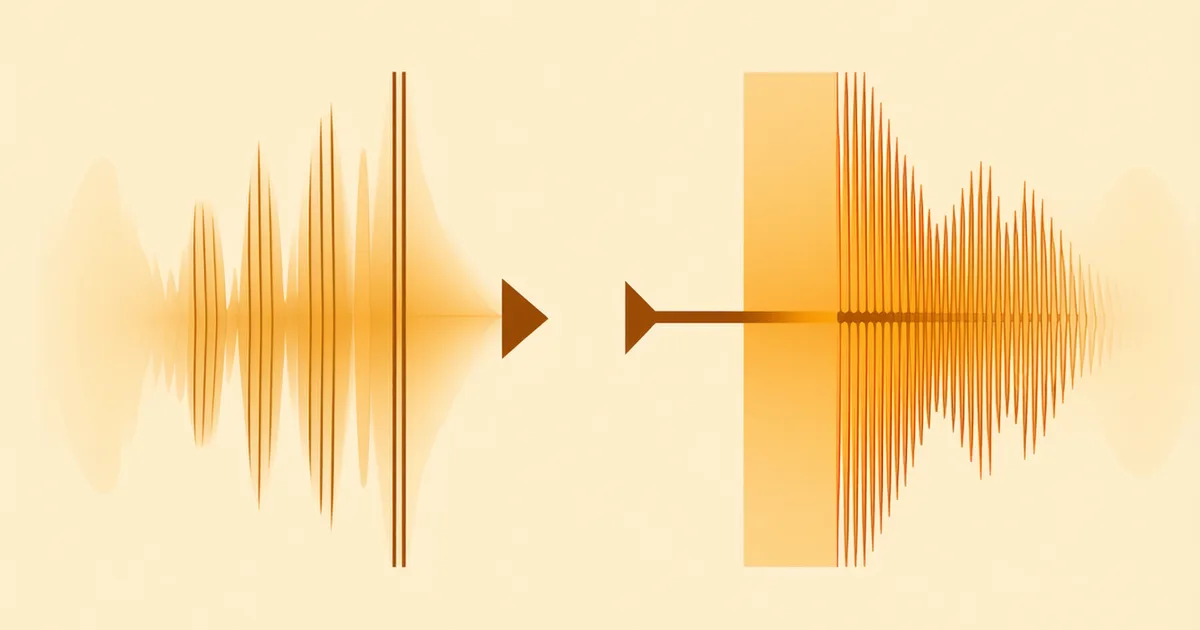
Two hosts record a 60-minute interview on separate machines. When they open the multi-track session afterward, the host's track and the guest's track no longer line up. Not by a lot — maybe 80 milliseconds. But the guest's sentences are arriving just a fraction of a beat late, which creates a subtle but maddening echo effect whenever voices overlap or one speaker immediately follows the other. That gap was not there at minute one. It accumulated, silently, over the course of the session.
This is clock drift, and it's one of the least-discussed problems in remote podcast production. It's silent during recording, invisible in loudness meters, and only shows up when you stack the tracks in your DAW and press play.
Why clocks drift: the technical explanation
Every audio interface — USB microphone, dedicated interface, or built-in sound card — has an oscillator that sets its sample clock. At 48kHz, this oscillator fires 48,000 times per second to trigger each sample capture. The nominal rate is 48,000 samples per second, but no oscillator is perfectly accurate. Consumer-grade USB audio interfaces typically operate within a tolerance of ±50 ppm (parts per million). At 48 kHz, 50 ppm equals approximately 2.4 samples per second of drift. Over 60 minutes, that accumulates to roughly 8,640 samples — which at 48 kHz represents about 180 milliseconds of potential drift in the worst case, and typically 5–15 ms in practice for devices within ±10–30 ppm of nominal.
The drift rate is not consistent across machines. One laptop running macOS might be disciplined by an NTP-synced software clock that adjusts the audio driver's effective sample rate periodically. Another running Windows with a USB audio interface that uses a hardware clock unlinked to the system time will drift at its oscillator's native rate with no correction. The combination of these two machines over a 90-minute session produces an unpredictable and non-linear misalignment — not a clean offset you can correct with a simple shift, but a gradual stretching of one track relative to the other.
At 48 kHz, a 3–9 ms cumulative drift over 60 minutes (a realistic range for typical consumer hardware combinations) sounds like a slapback echo on conversational handoffs. At 15 ms or more — possible in long sessions with mismatched hardware — the effect becomes clearly audible even on passages where one speaker is talking uninterrupted, because the waveforms from ambient room sound captured by both microphones no longer cancel cleanly when the tracks are mixed.
Sample-rate mismatches compound the problem
Drift within a single nominal rate (both machines at 48 kHz) is the baseline problem. Sample-rate mismatches — one machine recording at 44.1 kHz, another at 48 kHz — are a different failure mode that produces a constant, linear drift rather than an oscillator-variance drift.
The math is straightforward: 44,100 samples per second versus 48,000 samples per second. Over 60 minutes, a 44.1 kHz recording contains 158,760,000 samples and a 48 kHz recording contains 172,800,000 samples. When you load both into a DAW expecting 48 kHz, the shorter-sample-count file will be 8.16% shorter in duration — not 8 ms but 8.16% of the total length, which for a 60-minute interview is almost 5 full minutes. You can't manually time-stretch your way out of that cleanly in post.
This happens more often than it should. A guest joins a session using their laptop's built-in microphone, which defaults to the OS sample rate. macOS defaults to 44.1 kHz in many configurations; Windows defaults vary by driver. The host's USB interface is set to 48 kHz in the recording software. Neither participant knows this until the editor opens the session.
What drift correction actually does
Drift correction is not a simple time shift. It's a timestamp re-anchoring process applied to the audio stream after the session, using reference points embedded in each participant's recording.
The approach used in Rebel Audio's drift correction pipeline: each browser tab participating in a session writes a shared session clock reference — an NTP-synchronized timestamp — into the BWF metadata of the audio file at session start. Throughout the session, periodic synchronization markers are embedded in the audio stream at the application layer. After upload, the alignment algorithm compares the timestamps from each participant's file against the shared clock reference and calculates the per-second drift rate between them.
The correction is applied as a time-stretch operation — not pitch-shifting (the rate change required is so small, typically under 0.02%, that no audible pitch artifact is introduced), but a re-sampling that expands or compresses the audio stream by the calculated drift amount. The output is a file whose duration matches the reference clock, with the accumulated drift removed. For a 90-minute session with a 100ms cumulative drift, the correction stretches or compresses approximately 0.11% of the audio length — one sample adjustment per roughly 900 samples at 48 kHz.
A concrete scenario: the wrestling commentary show
Consider an indie wrestling commentary show — two hosts, weekly releases, around 8k monthly listeners — recording a 75-minute post-event breakdown episode. The primary host is on a desktop PC with an XLR interface running at 48 kHz. The co-host is on a MacBook using a USB condenser microphone that their OS has clocked at 44.1 kHz due to a persistent system audio setting they've never changed.
Without drift correction and sample-rate normalization, this session produces two files with a diverging offset. At minute 30, the co-host's track is already 2.3 seconds behind the host's track. The hosts don't notice during the live session because they're hearing each other through the WebRTC monitoring connection, which has its own buffering. The editor opens the session, sees the two waveforms visually misaligned, attempts a manual re-sync, and gets it approximately right at the top of the file — but by the end of the episode, they've drifted apart again because the initial alignment doesn't account for the sample-rate difference as a rate mismatch rather than a fixed offset.
With drift correction applied: the 44.1 kHz file is detected at ingest, resampled to 48 kHz before the drift calculation runs, and the resulting BWF files arrive at the editor's timeline already correctly aligned. The editor loads the session, sees two waveforms that start together and stay together through minute 75, and proceeds directly to content editing.
The limits of automated drift correction
We are not saying drift correction eliminates all sync issues in a multi-track remote recording. We are saying it handles the systematic, predictable sources of misalignment — oscillator variance and sample-rate mismatch — that are guaranteed to exist in any remote session on consumer hardware.
What drift correction does not address: large content gaps caused by recording interruptions (the guest closed the browser tab at minute 30 and rejoined five minutes later), or non-linear drift caused by CPU throttling events that temporarily slow the audio processing pipeline on one machine. These produce discontinuities in the audio stream, not continuous drift, and they require editorial judgment rather than algorithmic correction.
The NTP sync reference also assumes both machines have functioning internet time synchronization. Machines with significantly incorrect system clocks — a scenario common with infrequently used guest devices — can produce larger initial offset errors that the algorithm has to account for. Rebel Audio's alignment uses multiple internal sync markers throughout the session rather than relying solely on the session-start timestamp, which reduces the impact of a bad initial NTP reading.
Why it matters for the editing workflow
For a show that exports multi-track stems to Hindenburg Journalist or Reaper, receiving pre-aligned BWF files changes the editing session from a 20-minute manual alignment exercise into an immediate content review. The editor imports the stems, they sit at the right positions, and the work begins on timing, content, and sound quality rather than on fixing something the recording infrastructure should have handled.
For shows where the host is also the editor — which describes the majority of indie podcasts at the 3k–30k download range — this matters even more. Every extra step between raw recording and publishable episode is friction that accumulates across weeks and years of a show's production life. Drift correction is infrastructure. It should be invisible, it should be automatic, and it should never be the reason an episode ships late.